

Independent artists don’t have unlimited budgets.
Most are funding their music careers out of pocket, going into debt, juggling day jobs, and making calculated decisions about where every dollar goes. So when someone charges them thousands of dollars to pitch their music and can’t show them a single thing they actually did, that’s not a grey area. That’s predatory.
I’ve been watching this happen for a while. I’m done just watching.
What They’re Selling You Isn’t Marketing
Let’s start here, because this is the part that bothers me most.
Playlist pitching is not music marketing. Getting your song submitted to SiriusXM is not music marketing. These are tactics …
They can be useful tactics. But a tactic without a strategy behind it is just a coin flip with a price tag attached.
Real music marketing means someone has looked at who you are as an artist, where you’re going, who your audience is, and built a plan that makes all of your activity point in the same direction.
Playlist placement can be part of that plan. But it is not the plan.
When someone charges you $1,500 to pitch your song to playlists and calls it marketing, they’re using the word wrong. What they’re doing is closer to a distribution service. And frankly, it’s one you could do yourself for a fraction of the cost.
RELATED: Find the right people to join your team …
The Transparency Problem
Anyone can create an account on Playlist Push, SubmitHub, or Daily Playlists and start pitching songs within an hour. These tools are designed to be accessible. They are not overly expensive. They are nowhere near the rates some people are charging artists to use them on their behalf.
That gap between what the tool costs and what the artist is charged? That’s where the problem lives.
If you’re running a legitimate service, you should be able to tell your client exactly which platform you used, exactly what it cost, and exactly what happened. That’s not a high bar. That’s just basic accountability for money someone trusted you with.
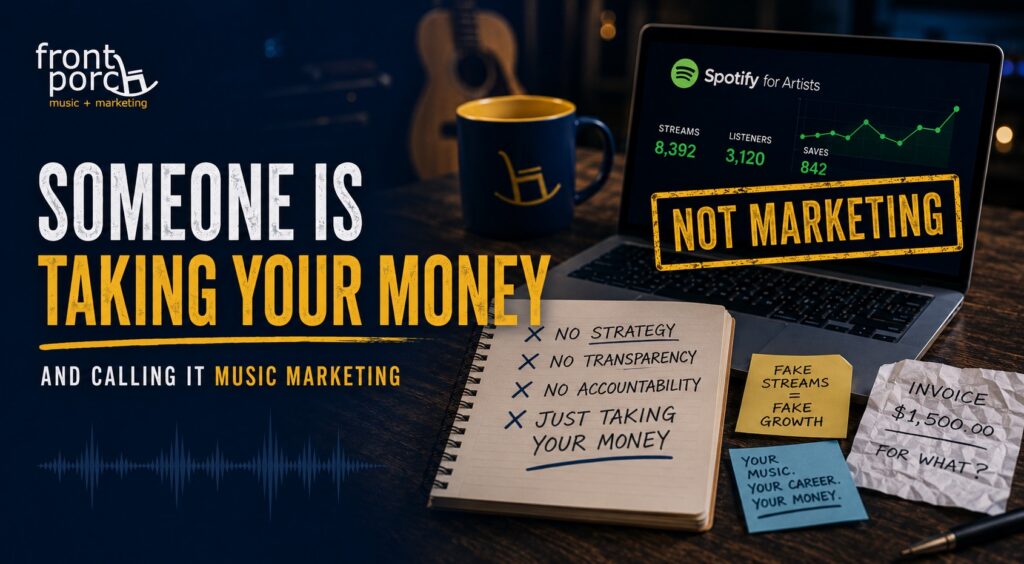
If the reporting you receive at the end of a campaign is a screenshot from Spotify for Artists, that’s a red flag. That data is already yours. You didn’t pay someone to show you your own dashboard.
This Can Actually Hurt You
This isn’t only about wasted money.
Some playlisting services operate outside of Spotify’s Terms of Service. I personally know artists who paid people to get their music placed, only to have their songs removed from DSPs entirely.
That’s the worst case scenario of trusting the wrong person with your music. Your song disappears from the platforms you worked to get it on, and the person who caused it already has your money.
Before you pay anyone to pitch your music, ask them directly which platforms they’re using and confirm those platforms are compliant.
If they get defensive or vague, that’s your answer.
A quick note on fake streams: The streams you get from these non-compliant services aren’t real. The people behind those plays will never become real fans, and they will never do anything to support your career. You cannot build something on numbers that mean nothing.
Questions You Should Be Asking Before You Pay Anyone
These are the questions that separate legitimate services from “marketers” that are just taking your money:
- What playlisting service are you using, and how much does a campaign on that platform actually cost? This tells you what you’re paying for the tool versus the person’s time and access.
- Which playlists were pitched?
- What was the feedback? Some artists don’t want to know, and that’s fair. But you should have the option.
- Which playlists added the song, and how do you know it was a result of the pitch rather than organic discovery? A sudden spike in streams from a country that has no connection to your audience is a red flag.
- What does the pitch to SiriusXM actually say? Does it sound like you, or does it read like a generic template being sent for every artist on their roster?
- What was SiriusXM’s response?
- What is their success rate for SiriusXM placements overall?
On that last point: SiriusXM accepts direct submissions at siriusxm.ca/music-submissions. You can do that yourself, at no cost.
Worth knowing before you pay someone else to do it …
A Note on My Own Bias
Just to be clear … I’ve done playlist pitching for clients. I’ll be straight about that. It has always been one piece of a larger strategy and has never been something I’ve invoiced separately. I’m not writing this from some place above the industry.
I’m writing it because this industry is full of people who genuinely love music and want to build something, and there are others who have figured out how to monetize that ambition without delivering anything real in return.
That’s the part I can’t get comfortable with.
To the People Running These Services
If you’re doing this work honestly, none of this is about you. Keep going.
But if you’re charging artists significant money to click a few buttons on a platform they’ve never heard of, sending a generic pitch to SiriusXM that could apply to literally anyone, and handing over a Spotify screenshot as your final report, you need to take a hard look at what you’re actually providing.
Artists deserve better than that.
And this industry is small enough that the way you treat people tends to catch up with you.
RELATED: Find the right people to join your team …
The Bottom Line
Ask questions. Ask for receipts. Know who is representing you and what they’re saying on your behalf.
You work too hard on your music not to get an honest answer about where it went.

Logan Miller
As the founder of Front Porch Music, I believe that music has the ability to connect people. I love country music, and I love the country music industry as a whole. My goal is to help music fans find new artists to fall in love with.